
ASCVD 10-Year Risk Calculator: How to Use the Pooled Cohort Equations
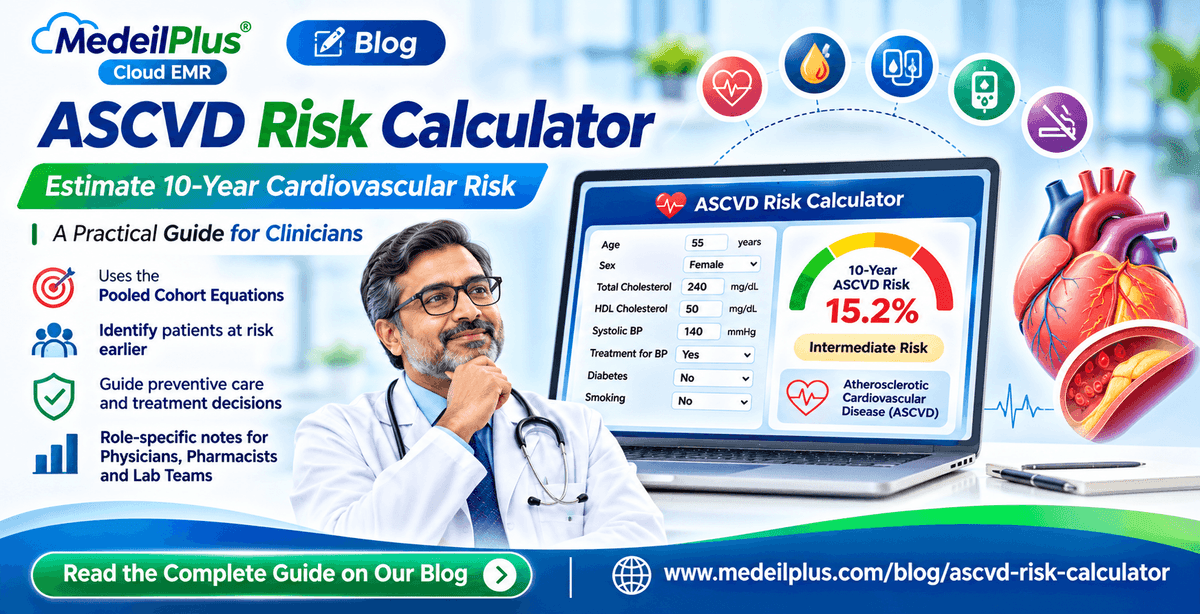
Estimate 10-year ASCVD risk with the Pooled Cohort Equations. A guide for physicians, pharmacists and lab teams, with unit conversion and clinical caveats.
URL: /blog/ascvd-10-year-risk-calculator-guide
What is 10-year ASCVD risk?
10-year ASCVD risk is an estimate of the chance that a person without known atherosclerotic cardiovascular disease will have a first heart attack, stroke, or cardiovascular death in the next ten years. Clinicians use it to decide whether preventive treatment, such as a statin, should be discussed. You can calculate it with the ASCVD 10-year risk calculator.
Who should be assessed
Routine 10-year assessment applies to adults aged 40 to 75. For adults aged 20 to 39, the guideline recommends assessing risk factors every 4 to 6 years, with a 30-year risk estimate where appropriate. The UIC pharmacy FAQ summarizes these recommendations.
The Pooled Cohort Equations apply to people without known cardiovascular disease or diabetes who have an LDL cholesterol of 70 to 189 mg/dL. Outside that group, other decisions apply.
What each role needs to get right
Physicians use the estimate for the primary-prevention decision. Confirm the age range and LDL window first. Then check whether the estimate fits the clinical picture, since the calculator is a guide and not a diagnosis.
Pharmacists use the estimate in statin counseling. The most useful step is explaining the risk tier in plain terms, along with what treatment would and would not change.
Lab technicians supply the values behind the estimate. Total cholesterol and HDL must be reported in the units the calculator expects, usually mg/dL. Many labs report in mmol/L, and the same LDL window appears as 1.81 to 4.90 mmol/L. To convert cholesterol from mmol/L to mg/dL, multiply by 38.67. A unit mismatch can change the result without any visible error. Use the unit converter to check values before they reach the clinician.
Worked example
Use these sample inputs to practice. They are not patient data.
Age: 58
Sex: male
Race group: White
Total cholesterol: 213 mg/dL
HDL cholesterol: 50 mg/dL
Systolic blood pressure: 138 mmHg
Treated for hypertension: yes
Current smoker: no
Diabetes: no
Enter these in the calculator and compare the result with the output shown on the page. [Confirm the output displays for a logged-out visitor before publishing.]
Limits and caveats
The Pooled Cohort Equations are not perfect. Several studies suggest the calculator substantially over-estimates 10-year risk in some populations. Results should be interpreted alongside the patient’s full clinical picture.
The race categories follow the equations. The guidance on them is dated. One source notes that current guidelines suggest using the “Caucasian” category given the lack of data, and that further research is needed to stratify risk across groups.
PCE or PREVENT?
The Pooled Cohort Equations are from 2013 and still appear in the 2019 ACC/AHA guideline. The AHA’s PREVENT calculator is newer and was published after that guideline, so the guideline does not mention it. This tool implements only the Pooled Cohort Equations. Check which calculator your local guidance or institution uses before choosing one.
Frequently asked questions
What is the ASCVD risk calculator?
It estimates 10-year risk of a first atherosclerotic cardiovascular event for adults without known ASCVD, using the Pooled Cohort Equations.
Who should use the ASCVD 10-year risk calculator?
It is intended for adults aged 40 to 75 without known cardiovascular disease or diabetes, with LDL between 70 and 189 mg/dL.
Which units does the calculator use?
Cholesterol is entered in mg/dL. To convert from mmol/L, multiply by 38.67.
Is the calculator accurate for every patient?
No. Studies suggest it can over-estimate risk, and it does not account for every factor that affects an individual patient.
What is the difference between PCE and PREVENT?
Both estimate cardiovascular risk. PREVENT is newer and was published after the 2019 guideline. This tool uses the Pooled Cohort Equations.
Does the calculator replace clinical judgment?
No. It supports the decision. It does not replace clinical judgment.
Sources
UIC College of Pharmacy FAQ on ASCVD calculators: https://dig.pharmacy.uic.edu/faqs/2024-2/june-2024-faqs/what-are-the-features-of-calculators-used-to-estimated-cardiovascular-disease-risk/
ACC ASCVD Risk Estimator: https://tools.acc.org/ASCVD-Risk-estimator/
ClinCalc ASCVD Risk Calculator (PCE 2013): https://clincalc.com/cardiology/ascvd/PooledCohort.aspx
MDCalc ASCVD 2013 Risk Calculator: https://mdcalc.scholasticahq.com/article/154426
Enjoyed This Article?
Stay informed with practical insights, industry trends, expert guidance, and educational resources designed to help professionals make better decisions.
Have questions or need guidance? We're happy to help.